
The DMV just went to production

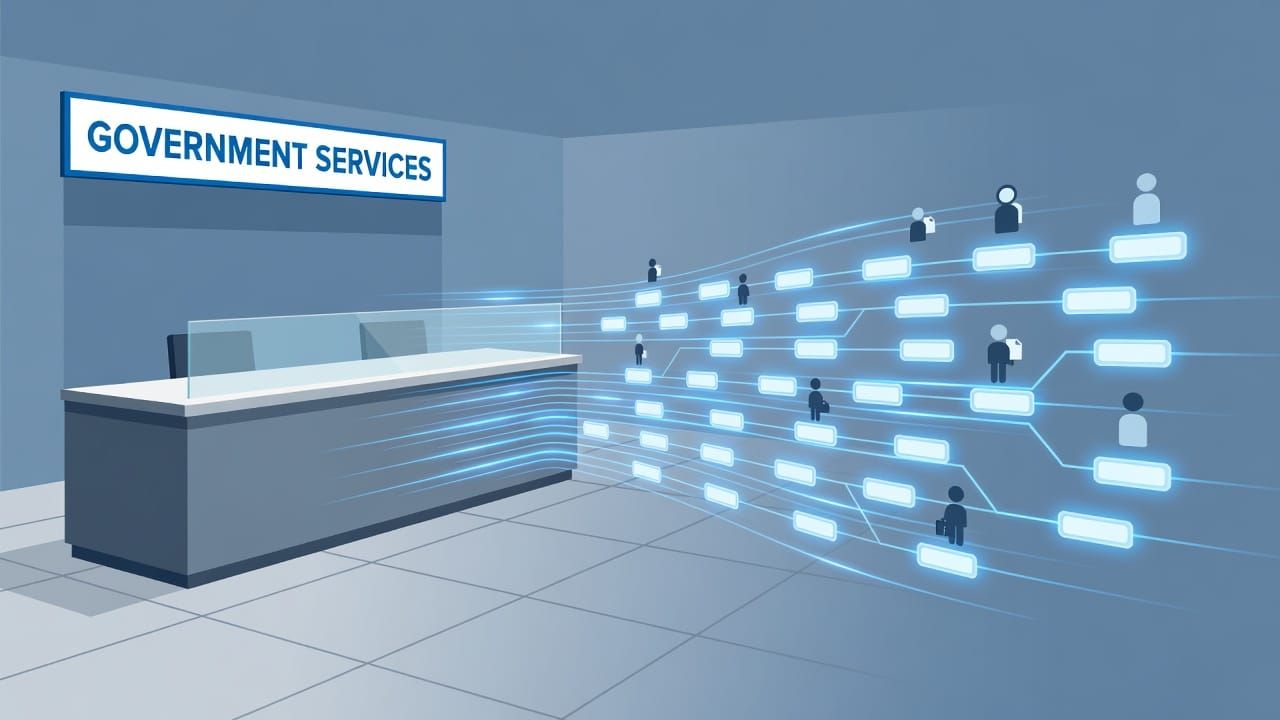
California put Claude in the DMV. That's the whole story, and it should end the excuses.
The state announced the largest government AI deployment in US history. Claude in the DMV queue. Claude in Medicaid casework. Every agency gets it at 50%. Read the full release here, but the headline holds: the most process-bound employer in America moved a live public queue to production.
So "we're not ready" is a choice now. It stopped being a condition.
Think about what the DMV actually is. It's the ultimate scripted queue. High volume, narrow questions, the same twenty things asked ten thousand times a day. Where's my registration. How do I renew. What do I bring for a REAL ID. These have canonical answers, and canonical answers are the exact profile AI clears first. The DMV isn't the hard case. It's the easy one that everyone assumed was hard because the line is long.
You look at a slow, painful, bureaucratic queue and you assume it's complex. It's the opposite. Slow and scripted is the best possible place to start.
Now the numbers, because I'd rather be concrete than cheer.
Median tier-1 deflection lands around 41.2%. That means AI closes roughly four in ten front-line tickets with no human touch. Each AI resolution runs about $0.62. The human version runs about $7.40. So you're not shaving a cost. You're moving the decimal point. On a DMV-scale queue, that gap compounds every single day the line exists.
62% of failed customer-service AI projects die on data prep, not on the model. The model works. The model has worked for a while. What kills the project is a mess of answers that contradict each other, live in six places, and were last updated by someone who left. Fix the answers and the thing ships. Skip that and the smartest model in the world will confidently tell your customer the wrong hours.
The model is not your bottleneck. Your knowledge is.
I've watched this from inside. We ship AI for prosecutors, and the government buyer wants one thing before anything else: show me the audit trail. Prove every answer. At first that reads like friction. It's actually the useful constraint. When you're forced to make every answer traceable, you're forced to make every answer clean, and clean is the whole game. The compliance bar and the quality bar turn out to be the same bar.
So the objection I hear next is "my team can't handle a rollout." Good. Don't do a rollout.
A rollout is a year, a committee, and a slide deck nobody reads. That's not the move. The move is one person and one afternoon.
Put It to Work
Pick your DMV-est queue. The highest-volume, most-scripted inbound you've got. The one where the same questions arrive in a loop and your best people are bored answering them. Pull the top twenty question categories from the last ninety days. Then mark each one honestly: does this have a canonical answer clean enough to hand a customer without making them angry?
Some will. Some won't. That list is the entire project.
The clean ones are your first deflection targets. The messy ones aren't AI problems. They're documentation problems you've been carrying for years, and the AI just made them visible. Either way you win, because now you know exactly where the work is and it isn't hidden anymore.
This is why the DMV story matters past the headline. Not because a big agency bought software. Because it proves the constraint you've been hiding behind is imaginary. If a state with a thousand rules, a union, a legislature, and a public watching can move a live queue, your five-person support team can pull a spreadsheet.
The gap between them and you isn't capability. It's the afternoon nobody's booked yet.
Software that describes the work is easy to admire. Software that does the work is easy to measure, and this is measurable today. Forty percent off your front line. Sixty cents a resolution. One person, one queue, one list of twenty.