
The only winners of AI are inside the arena
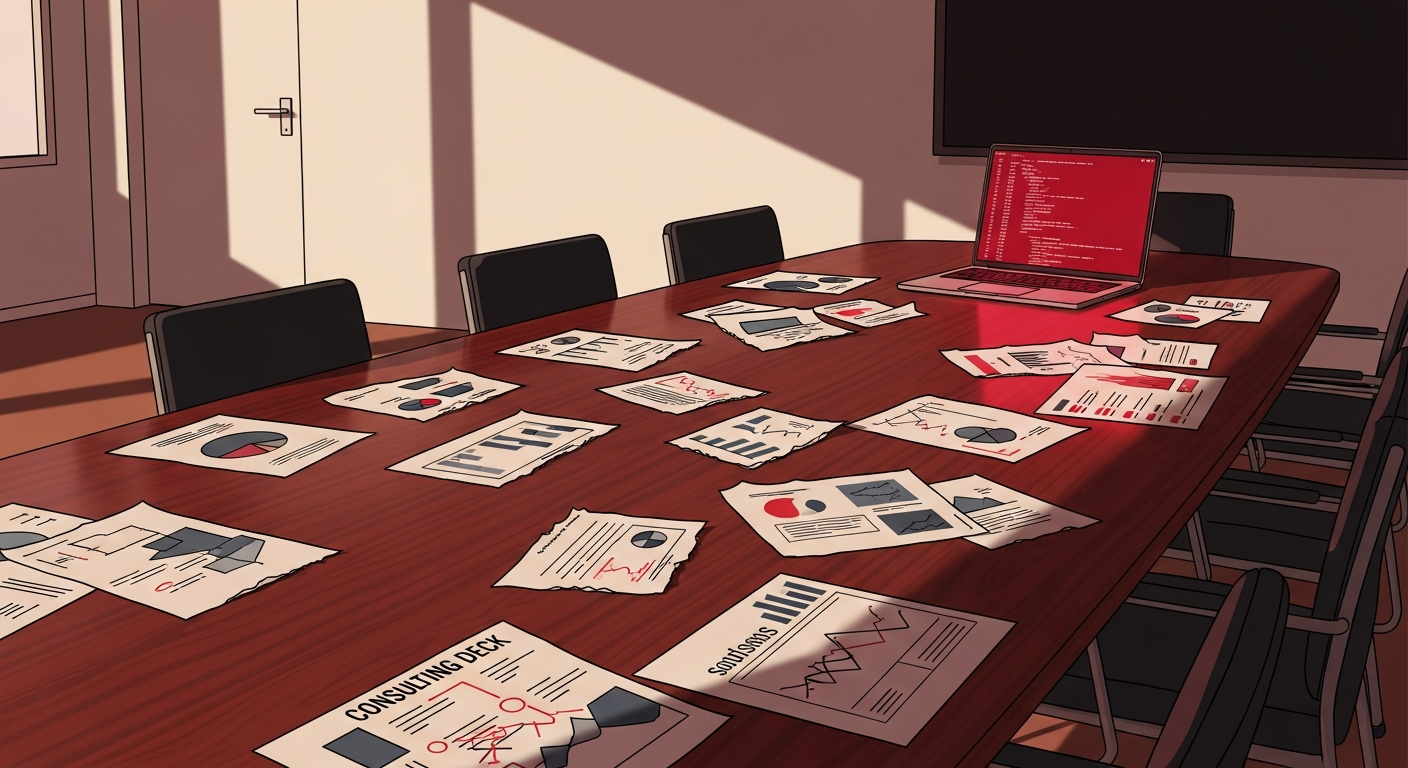
The first AI chatbot we built for SouthWorth ingested 60-page financial docs into a local vector database via a RAG workflow. It was magic. It was also never used.
We started Cosmos Holdings because we think AI is the most consequential technology shift since the internet, and almost everyone in our market is getting it wrong, just like we did.
The mistake comes in two flavors. The first is ignoring AI entirely, treating it like crypto or VR, a hype cycle you can sit out. The second is buying a "GenAI strategy" deck from a Big Six consultant, deploying a chatbot, and calling it a win.
Both are versions of the same error: attempts to understand AI from outside it.
The true business transformation is happening in the arena. That means not delegating, not reading about it, not waiting.
Two failure modes, one root cause
Mid-market PE and professional-services operators tend to fall into one of two camps right now.
The first camp dismisses AI as overhyped. They watched the dot-com bust, the crypto winter, the metaverse face-plant. Pattern recognition tells them to wait. The problem: this pattern doesn't hold. Engineering teams are shipping at 2-3x prior velocity. Contract review that used to take days is taking minutes. Support deflection rates are crossing 60% at companies in the mid-market. The wait-and-see camp is shedding margin every quarter to firms that already moved.
The second camp hires a consultant, gets a deck, and deploys something. Usually a chatbot. Or a single-vendor workflow that costs $200k and replaces no actual work. They've technically adopted AI. The economic return is negative.
There is no "staying on top of AI"
I read the same Substacks, listen to the same podcasts, watch the same YouTube explainers as everyone else does. They are useful for keeping vocabulary current. They cannot teach you AI.
The technology is moving faster than the content can describe it. Model context windows went from 8k tokens to 1M to 2M in eighteen months. Agent frameworks that were state-of-the-art in March were obsolete by August. The thing you watched on YouTube last month has been replaced by something three nodes downstream that the YouTuber doesn't know exists yet.
You cannot stay on top of AI from the outside. You can only stay on top by being in it: building agents, running them in production, hitting their limits, watching them fail, and shipping the next version. The knowledge has a half-life measured in weeks. The only durable thing is the muscle of building.
This is why I started a technology division inside an investment platform, not as a research arm, but as an operating arm. We are not advising portfolio companies what to do. We are doing it ourselves, in the open, and writing about what works and what does not.
AI is a vicious teacher
The arena is brutal. Every operator I know who has actually deployed AI has the same set of scars. Prompts that worked yesterday and fail today after a model update. Agentic workflows that hit a $4,000 OpenAI bill in one rogue overnight run. Mock tests that passed before a production migration broke everything. Compliance reviews that surfaced concerns three months after the build was supposedly done.
Failure in AI is faster than in traditional software. And it costs more. A blown integration in an ERP costs a week and a hotfix. A blown integration in an LLM workflow can cost you weeks of context, an embarrassed customer, and a five-figure API bill.
But those failures are the only real curriculum. Each one teaches you a kernel. This prompt structure is unstable. This model is not deterministic on this task. This guardrail leaks. This context window collapses past 200k tokens. Each kernel rolls into the next attempt.
Velocity compounds in AI faster than in any technology I have worked with. A team that has been building, failing, and shipping AI for nine months does not have 9x the knowledge of a team that started last month. They have something closer to 50x. Each kernel they own makes the next attempt cheaper, faster, and less likely to repeat the same failure mode.
The companies that win the next five years will not be the companies with the best AI strategy decks. They will be the companies that started failing the earliest.
You cannot learn AI from outside it. You can only build, fail, ship, and let the kernels compound.
Put It to Work
If you run a mid-market business or sit on the cap table of one, pick one process: accounts payable, contract review, intake screening, anything, and stand up a working prototype this week. Not a vendor demo. Not a Notion doc about strategy. A thing that runs.
That is how you start.